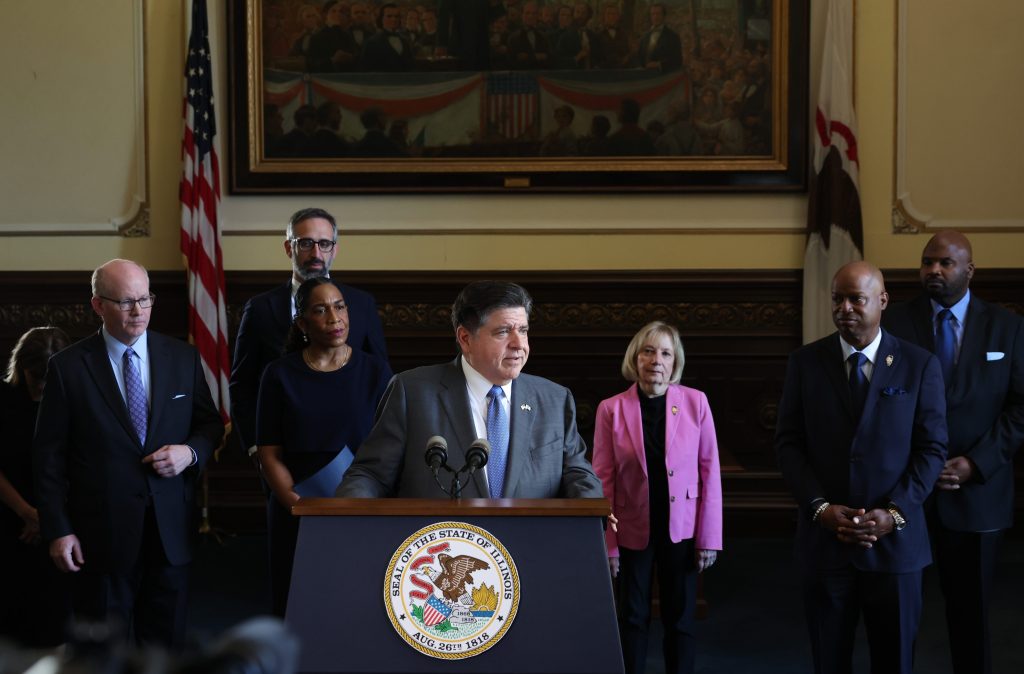
SPRINGFIELD — Speaking in his ceremonial office at the Illinois State Capitol hours after lawmakers voted early Monday morning to approve a nearly $56 billion election-year state spending plan, Gov. JB Pritzker made his case that eight years of his financial stewardship have put a once-struggling state on sounder footing.
Pointing to improved credit ratings, reduced pension liabilities and a replenished, albeit still comparatively small, rainy-day fund, Pritzker previewed the themes likely to define his bid for a rare third term as governor in November.
“From start to finish, the work of the legislative session we just completed was informed by the priorities and values of Illinois families, like lowering costs, investing in and protecting our children, laying the foundation for long-term economic development and job creation, and improving our state’s overall fiscal health,” Pritzker said.
But the spring session he celebrated also had some business that went unfinished. A deal to help keep the Chicago Bears in Illinois collapsed in overtime. The majority of a Pritzker-backed suite of proposals to address high housing prices never came to fruition, perhaps overshadowed by the more routine work of adopting a spending-and-tax plan for the budget year that begins July 1.
And Pritzker and fellow Democrats faced the familiar tension of trying to balance growing calls from the progressive left to generate more revenue to support state programs with a more centrist desire to avoid alienating business interests.
Further blending budget-making and politics, Pritzker and the legislature’s top Democratic leaders, Senate President Don Harmon of Oak Park and House Speaker Emanuel “Chris” Welch of Hillside, blamed Republican President Donald Trump for economic chaos and federal funding cuts that they say made crafting the state’s spending plan even more challenging than usual.
“Donald Trump and Republicans in Congress are costing the state over $8 billion — $8 billion — and Trump’s incomprehensible across-the-board tariff policies are taxing working families, while rising gas prices from his war of choice in Iran cost Illinois drivers $450 million per month,” Pritzker said. “It’s hurting families and businesses alike, and that puts a greater burden on our state budget.”

In an ironic move, the Democratic budget relies in part on a windfall created by those same high gas prices. The state collects a 6.25% sales tax on gasoline, and Democrats are diverting $150 million of that unexpected surplus — money that otherwise would go to mass transit — into the state’s operating budget.
“We need to do everything we possibly can in order to pay back what the federal government has taken away from the people of the state of Illinois,” Pritzker said in defense of the move. “That happens to be something that is assisting people in the state when the federal government has done absolutely nothing to help people.”
Aside from the gas sales tax diversion, the budget draws on $200 million in new revenue from a per-user tax on large social media companies, $300 million from extending a cap on corporate deductions for operating losses on state taxes and about $60 million from a new tax on cryptocurrency brokers. The plan also shifts $79 million in sales tax revenue from candy, soft drinks and grooming products — money that normally funds capital construction — into the operating budget.
In a win for progressive Democratic lawmakers, who got some backup from moderate colleagues in pushing for more revenue to stave off cuts, the revenue package authorizes new taxes on targeted digital advertising and online prediction markets, and it separates Illinois law from federal tax changes benefiting business owners who sell stocks. But the spending plan doesn’t rely on any immediate income from those proposals, given uncertainty over their legality and revenue-generating potential.
Democrats in the House followed guiding principles in budget negotiations, Welch said: “People who work hard shouldn’t feel like every day is such a struggle. Opening a bill shouldn’t feel so scary. No one should have to choose between their medication or putting food on the table.”
“These conversations that families have around their kitchen tables are at the heart of our agenda here in Illinois, and that’s why we were able to deliver a fiscally and socially responsible budget that moves forward while Washington is choosing to retreat every single day,” he said.
Acknowledging that “Illinois cannot undo every reckless decision being made in Washington,” Harmon said Senate Democrats were focused on “strengthening safety net programs to help as many as we can,” “protecting access to hospitals and healthcare in communities all across Illinois” and “continuing to invest in the future of our children, even when the federal government on a daily basis wreaks havoc on public education.”

The spending plan, which totals $55.9 billion for day-to-day state operations and still requires Pritzker’s signature, includes a $350 million funding increase for elementary and secondary education for a total expenditure of $10.8 billion from the general fund, and an $118 million infusion for safety-net hospitals, which serve high percentages of Medicaid patients.
Democrats also are creating a $70 million program to direct food assistance to Illinois residents who are booted from the main federal food aid program due to new requirements the Trump administration says will crack down on benefits fraud. Under the state program, one-time payments of $400 would automatically go to people who lost benefits due to new federal work requirements. Last year, Trump signed a sweeping Republican-led package that expanded work requirements for receiving benefits from the Supplemental Nutrition Assistance Program, or SNAP, to previously exempt groups such as adults ages 55 to 64.
Nodding to affordability concerns in an election year, Democrats also revived some election-year tax breaks they used in 2022, the last time Pritzker was on the ballot.
Those include a six-month pause on an inflation-based increase of a separate per-gallon gasoline tax — which otherwise would go up by 1.3 cents, to 49.6 cents per gallon, on July 1 — and a 10-day “sales tax holiday,” from Aug. 7 to 16, for back-to-school shoppers.
Republicans in the legislature’s superminority, none of whom voted for the budget package, offered grudging credit to Democrats for a more collaborative process but nevertheless blasted both the substance of the plan and the last-minute rush to bring its components to the House and Senate floors for votes.
“For years, the majority party has demonstrated an insatiable appetite for spending, while refusing to confront one of the biggest challenges facing Illinois families: some of the highest property taxes in the entire nation,” said Sen. Don DeWitte, of St. Charles, a former mayor who criticized the budget plan for not directing more state income tax revenue to local governments. “The answer to every problem cannot be to spend more money and send taxpayers a bigger bill. You cannot tax yourselves into economic stability. You have to grow yourself into it.”

Outside the statehouse, the Democrats’ budget package received mixed reviews.
The Illinois Federation of Teachers, now led by progressive Chicago Teachers Union President Stacy Davis Gates, criticized Pritzker and other Democrats for not pushing harder to place a state constitutional amendment referendum on the November ballot to authorize a so-called millionaires tax.
“Instead, they left most everyone else to figure out how to survive the impacts of Trump’s assault on working families and our state’s safety nets,” Davis Gates said in a statement.
Chicagoland Chamber of Commerce President and CEO Jack Lavin, meanwhile, praised Pritzker and lawmakers for their “continued focus on fiscal responsibility, passing a balanced budget, and maintaining the state’s long-term competitiveness and workforce.”
“The governor’s broader efforts to encourage investment, innovation, and economic growth are the most effective way to address our fiscal challenges,” Lavin said in a statement.
Still, the chamber was “disappointed policies like the digital advertising tax and social media tax were included in the budget.”
“These regressive and legally questionable taxes will make it harder and more expensive for businesses to operate at a time when employers are already navigating inflation, tariffs, supply chain challenges, and broader economic uncertainty,” Lavin said.
One area where business interests prevailed was that the final budget did not include Pritzker’s proposed two-year moratorium on tax incentives for data center construction. A separate measure that would have imposed strict water- and energy-use reporting requirements on the industry and required data centers to pay for their own energy costs also failed to advance before the legislature adjourned its spring session.
Chicago Tribune’s Olivia Olander contributed.


Leave a Reply