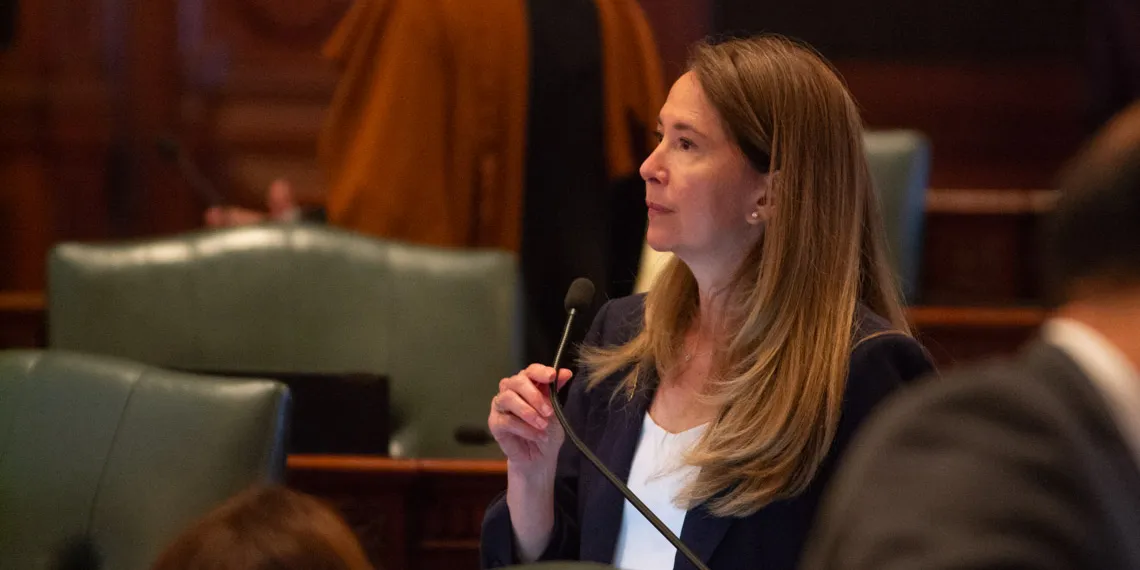
The measure passed with unanimous support in both chambers
SPRINGFIELD — Lawmakers on the final day of the General Assembly passed a bill to regulate how minors interact with social media and other online platforms to make them less addictive.
The goal of House Bill 5511, the Children’s Online Social Media Safety Act, is to prevent children under the age of 18 from being exposed to harmful content and addictive features by requiring social media companies to confirm a user’s age through the device’s operating system.
The bill doesn’t prevent children from downloading or using social media apps. During device set-up, parents would set the child’s age, which would adjust certain design features in apps such as algorithmic feeds, the visibility of the child’s profile and what media can be shown to them.
The bill passed the Senate unanimously on Monday with a vote of 57-0. It passed the House a second time on Monday with a 113-0 vote.
Gov. JB Pritzker proposed the bill during his February budget address, and he celebrated its passage on Monday and said he would sign it.
“I am proud the Illinois General Assembly passed the Children’s Online Social Media Safety Act, marking an important milestone in our efforts to improve kids’ safety and privacy online, mitigate the harmful effects of social media on mental and physical health, and prevent financial scamming,” Pritzker said in a statement.
Efforts to pass some kind of measure in Illinois have been ongoing for a few years.
“This legislation is about recognizing a simple reality: children are not miniature adults,” Sen. Willie Preston, D-Chicago, the bill’s sponsor, said at a Saturday committee meeting. “These platforms invest billions of dollars into capturing attention, maximizing engagement, keeping users online for as long as possible. When that system is directed at developing minds, the consequences will be and have proven to be devastating and sadly irreversible.”
The bill previously passed the House in April with a bipartisan vote of 82-27. The Senate version mainly increased privacy protections for minors and altered definitions to target the most harmful platforms.
“While this legislation is not perfect, lawmakers cannot continue waiting for the perfect solution while technology continues to evolve around us,” Sen. Sue Rezin, R-Morris, said in an emailed statement.
She helped work on some of the bill’s language and has advocated for youth social media protections for years.
What’s in the bill
The bill prohibits social media companies from using a minor’s viewing history or data stored on the device to determine what shows up in their feeds.
Instead, feeds for minors will only be allowed to show information the user requested or searched for, or was posted by a creator the user follows. Youths will also be able to see media that is a direct, private message to them.
Under the bill, platforms would be required to establish some default privacy settings for minors, shield a minor’s precise location and limit digital currency transactions. Social sites and apps would also be prohibited from sending notifications between 10 p.m. and 7 a.m.
The Illinois Attorney General’s office would enforce the law, which takes effect in 2028, if signed. Violators would be liable for fines up to $2,500 for each child for unintentional violations and up to $7,500 per child for intentional violations.
Lobbyists for tech companies raised concerns that the bill may violate the First Amendment and warned that it will likely face lawsuits. But the governor’s office said in a Saturday committee that the bill’s language is modeled after legislation in other states that have survived court challenges.
Rep. Jennifer Gong-Gershowitz, the House sponsor, said she doubted social media companies would ever be completely on board.
“I’m not sure we’re ever going to get complete neutrality from social media companies that are going to be asked to comply with this act in order to keep our kids safe from addictive algorithms that are frankly designed to keep them glued to these devices,” she said on the House floor. “But this is an incredibly important measure to address the most dangerous features of these devices, which is that they’re designed to be addictive to children.”



Leave a Reply