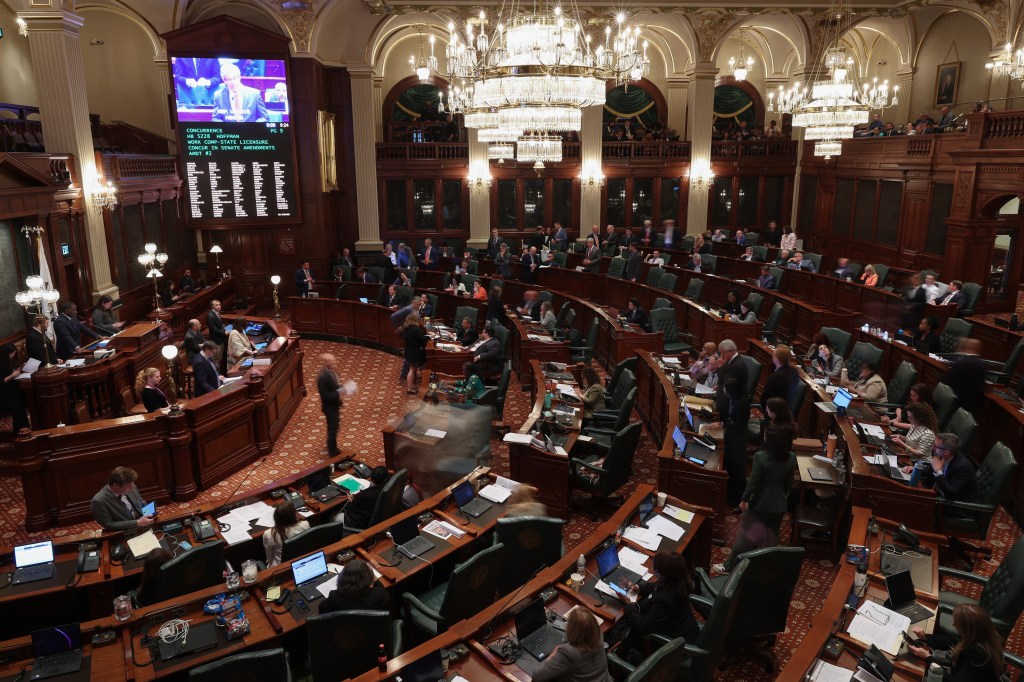
SPRINGFIELD — Illinois lawmakers went into overtime and worked into the early morning Monday to send Gov. JB Pritzker a nearly $56 billion election-year state spending plan that was balanced, in part, with an anticipated windfall of sales tax revenue resulting from soaring gas prices.
Pritzker and fellow Democrats are building their November general election campaigns around the issue of affordability, blaming Republican President Donald Trump and his allies for cuts to social programs and for rising prices on necessities — most notably gasoline, which has jumped from an average of about $2.91 per gallon in Chicago to $4.82 since the Iran war began in late February.


The final piece of the budget package was approved about 3 a.m. on a 37-21 vote in the Senate and about 4 a.m. in the House on a 76-39 party-line vote. In the Senate, three downstate and suburban Democrats joined Republicans in opposing the spending measure.
Debate over the state budget became infused with national politics as Democrats blamed Trump for economic and fiscal uncertainties facing Illinois and Republicans took thinly veiled shots at Pritzker for his perceived ambitions for higher office.
On the Senate floor early Monday, state Sen. Elgie Sims, a Chicago Democrat and lead budget negotiator, said the spending plan built on years of responsible budgeting since Pritzker took office in 2019.
“It’s allowed us to be prepared for the grave reality we face today, the reality of continuing uncertainty, the reality of federal cuts, the reality of chaos coming from Washington,” Sims said.


Republicans, however, painted a vastly different picture of the state’s finances, noting $16 billion in additional state spending during Pritzker’s two terms. While that’s a 40% increase in raw dollars, it’s a more modest 7.5% when adjusting for inflation.
“From Gov. Pritzker’s perspective … we must have the greatest economy anywhere,” said Sen. Chapin Rose of Mahomet, a Republican budget negotiator.
Criticizing the taxes Democrats used to balance their plan, Rose said, “No society in the history of Earth has taxed its way into prosperity — not one.”
In their 3,703-page spending plan, lawmakers included a 3.2% cost-of-living increase for themselves, boosting base salaries for all 177 members of the General Assembly to $101,450. That automatic, inflation-based increase breaks the six-figure salary mark for the part-time positions for the first time in Illinois history.
Salaries for the governor, other statewide elected officials and the heads of state agencies also would increase by about 3.2%, though Pritzker, the billionaire businessman and heir to the Hyatt Hotels fortune, does not take a salary. Lawmakers’ district office allowances would also see a funding boost, though pay for Springfield staff was expected to remain flat, House Democratic Leader Robyn Gabel of Evanston said at a hearing on the budget Sunday afternoon.
“This budget is not balanced on the backs of working families. That means no taxes on working people and no severe cuts to critical services they depend on,” Gabel said more than 12 hours later, as the budget approached a final vote in the House around 4 a.m. Monday.
The Democratic plan calls for overall spending of about $55.9 billion from the state’s all-purpose checking account during the budget year beginning July 1, with an anticipated year-end surplus of about $100 million.

The budget plan, the eighth since Pritzker first took office, comes as he seeks a rare third term and as Democrats look to maintain their dominance in the General Assembly. It includes a re-up of some election-year tax breaks they used last time the governor was on the ballot in 2022.
Those include a six-month pause on an inflation-based increase of a separate per-gallon gasoline tax — which otherwise would go up by 1.3 cents, to 49.6 cents per gallon, on July 1 — and a 10-day “sales tax holiday” for back-to-school shoppers.
Republicans in the legislature’s superminority criticized the Democratic framework for not going far enough to soften the blow of high gas prices while continuing to fund programs and services the GOP has long opposed.
During a House debate, Republican Rep. Joe Sosnowski of Rockford framed the delayed gas tax hike as an election-year gimmick.
“We’re just going to wait a couple of months so we can raise it at the end of the year, after election time,” Sosnowski said. “(A) lot of courage coming out of that side of the aisle.”
Temporarily sparing drivers from a 1.3-cent-per-gallon increase in the gas tax won’t result in significant savings, Rose said during a Sunday morning budget hearing, especially when Democrats are using a glut of revenue from a separate tax on gas sales to balance their spending plan.
“We ought to be suspending the sales tax on motor fuel right now, not diverting it to the general revenue fund,” Rose said.
Instead, Rose — a top Republican budget negotiator — said he’d rather see cuts in a similar amount of spending for immigrant services, in order to “give people their surplus in sales tax back.”
Spending on elementary and secondary education would increase by $350 million, meeting the minimum required under a 2017 school funding overhaul and restoring funding for a property tax relief grant program that was suspended for the current budget year. Pritzker had proposed continuing that freeze when he laid out his budget blueprint in February.
While meeting its minimum obligation for K-12 schools under the state’s so-called evidence-based funding formula, the budget would continue to underfund transportation grants to local school districts, including for special education students.
The spending plan, much of which stuck closely to Pritzker’s February proposal, would fund the state’s full required pension payment of $11.2 billion from the general fund, though fiscal watchdogs have long warned that those payments are insufficient to address the state’s gaping unfunded pension liabilities of about $144 billion.
Democrats said their plan would result in no layoffs of state employees and no closures of prisons or other state facilities. Neither would it fund the creation of many new large-scale programs.
It includes more than $100 million in additional funding to hire 100 new correctional officers and administrative staff for the state’s prisons, in line with the governor’s proposal, with the goal of reducing overtime hours.
Public universities would see state funding for operations increase by 3%, while community colleges would see a 1% bump.Funding for the grants to lower-income students through the Monetary Award Program would remain flat at nearly $722 million.
One major new program is a $70 million plan to direct food assistance to Illinois residents who are booted from the main federal food aid program due to new requirements the Trump administration says will crack down on benefits fraud.
Under the state program, one-time payments of $400 would automatically go out to people who lost benefits due to new federal work requirements. Last year, Trump signed into law a sweeping Republican-led package that expanded work requirements for receiving benefits from the Supplemental Nutrition Assistance Program, or SNAP, to previously exempt groups such as adults ages 55 to 64.
“We are facing a crisis. There are over 100,000 individuals who will lose SNAP benefits as a result of a hostile federal government, but we are responding directly to those challenges,” Sims said at Sunday’s hearing.

Republicans in the state Senate questioned the merits of payouts to people who have not met a federal requirement.
“Let’s find out why they no longer qualify before we decide to start handing out the $400 individual payment,” said Sen. Donald DeWitte, a St. Charles Republican.
DeWitte also noted the state faces a potential $700 million penalty in future years under Trump’s tax-and-spending package if Illinois does not achieve a higher level of payment accuracy. The vast majority of states at the time the federal law was passed did not meet the so-called error rate needed to avoid a penalty.
One of the major sticking points for Democrats in budget negotiations had been how aggressively to pursue new taxes to prevent spending freezes and cuts in what Pritzker had pitched as a “maintenance” budget.
Progressive lawmakers and their allies were unsuccessful in winning support for another attempt to ask voters to amend the state constitution to allow higher incomes to be taxed at higher rates, an effort that failed at the ballot box in 2020.
But progressives did succeed in the waning days of the spring legislative session in gathering enough support among more centrist Democrats for other revenue measures that would not directly affect average taxpayers.

Some proposals, including taxes on targeted digital advertising and prediction markets, appeared likely to be included in the final package but without any projected revenue factored into the spending plan, given uncertainty over their legality and revenue-generating potential. The revenue measure would also create a new 15% tax on post-payout revenue for companies that operate fantasy sports contests and grant the Illinois Gaming Board licensing authority over those companies.

Beyond the gas sales tax diversion, the plan also calls for a one-year shift of $79 million in tax revenues from sales of candy, soft drinks and grooming products — money that otherwise would go to capital construction projects — to the operating budget. It also relies on $200 million in new revenue from a Pritzker-proposed per-user tax on large social media companies.
The package also counts on $300 million in revenue from extending a cap on how much corporations can deduct from their state taxes for operating losses.
Apart from the budget, lawmakers voted overnight to delay the effective date of a controversial ban on certain credit card fees for another year, to July 2027.
Passed in 2024 to provide relief to retailers as part of that year’s budget package, the state law bans so-called swipe fees, also known as interchange fees, on the tax and tip portions of customers’ bills.
Financial institutions quickly sued. In February, a federal judge ruled that key provisions of the law could go into effect, a decision backed by retailers who supported the legislation, but banks and credit unions quickly appealed.

Rob Karr, CEO of the Illinois Retail Merchants Association, in remarks before the House Executive Committee on Sunday accused banks and their allies of choosing to “distract, distort, delay and demonize” in an effort to stop the legislation from going into effect for the past two years.
Chicago Tribune’s Jeremy Gorner and Jack O’Connor contributed.

Leave a Reply