CHICAGO — Different media responsibilities kept the three players representing Illinois at Big Ten Football Media Days occupied almost all day on Tuesday.
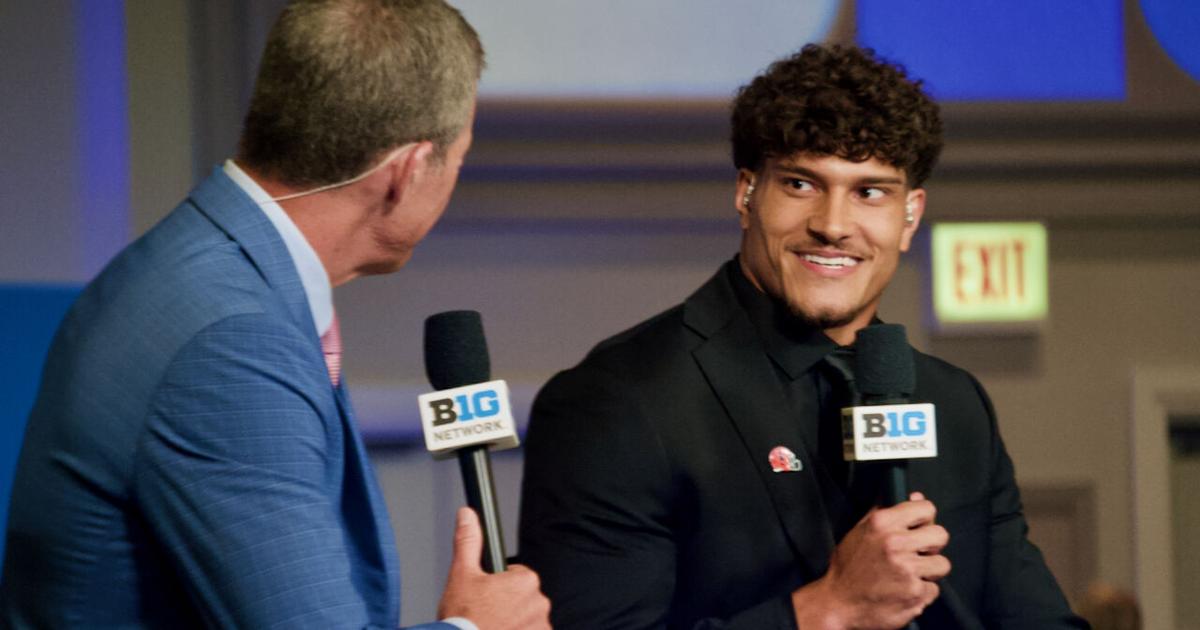
Toward the end of their schedule was an appearance on Big Ten Network with studio host Rick Pizzo. New quarterback Katin Houser certainly fielded several questions from Pizzo.
So did senior cornerback Juice Clarke.
But Matthew Bailey was the focal point.
Both Houser and Clarke often deferred to the veteran safety, who cut an imposing image in a black suit, black shirt and black tie with an orange Illinois helmet pin adorning his right lapel. Bailey was quick with an insightful answer and a smile on the live TV hit.
Bailey’s comfort level was reflective of the role he’s assumed on this Illinois team. Part push from the coaching staff. Part self-reflection from the fifth-year player out of Moline with 39 games of experience under his belt about what his team needed this fall.
Bailey understood the Illinois coaching staff wanted him to evolve as a leader heading into the 2026 season and take on more of a primary vocal role. He heard it from strength and conditioning coach Tank Wright during summer workouts and in his conversations with Illinois coach Bret Bielema.
But Bailey didn’t really need the prompting. He understood there was a void in the team. The time where he could operate under the radar as more of a low-key, lead-by-example player had passed.
Year five in Champaign and status as one of the key returning players on either side of the ball meant more was expected of Bailey this season as a leader.
Bailey’s Tuesday afternoon appearance on BTN from Chicago was simply the first glimpse.
“Before, there wasn’t necessarily a need for it,” Bailey said. “Guys had already stepped up. This year it was much more needed, and I noticed that. I felt that responsibility on my heart. So as much as it was emphasized by the coaches, I also intrinsically had to step up and knew I had to grow as a player and as a person to be able to speak vocally, speak in front of the team and speak in front of the defense of what my expectation is for the team.”
Being held out of spring practices as he recovered from offseason surgery on his right shoulder made his shift in leadership more complicated. The 6-foot-2, 225-pound safety wasn’t on the field, in the middle of the action, but it was a rare occasion he wasn’t pulling a younger teammate aside on the sideline to help explain a concept they were both learning at the same time in new defensive coordinator Bobby Hauck’s system.
Summer workouts provided more of an opportunity for Bailey to work on his leadership skills in the run-up to training camp, which opens Monday ahead of Illinois’ Sept. 3 season opener against UAB.
“He’s definitely been talking more — especially when we had our team runs in the summer,” Clarke said. “When it’s not what the standard is supposed to be, he gets in the middle, talks to us and gives us motivation. It’s up to us to get where he is.”
The move from leading by example to stepping up in front of the defense — or even the entire team — and vocalizing expectations or holding his teammates accountable didn’t exactly come to Bailey naturally.
Bielema never thought it would. The Illinois coach understands who Bailey is as a person. Understands he’s more on the quiet side. And he still emphasized why taking on that expanded leadership mantle was important. Doing so would help Bailey take the next step as a player with real NFL aspirations and benefit the Illini at the same time.
“I shared with him, ‘Listen, bro. It’s time for you to start talking,’” Bielema said. “’You’ve been here a couple years. You know what’s going on. You know what’s being said. You’ve got a great rapport with the players.’
“He had a really good example (in former Illinois safety Sydney Brown). That’s what I’ve pressed him on the last year or two. Now, you have to be the example. People should be doing what you do. I think his leadership has stepped up over the last year. I don’t have to demand it because he demands it out of himself.”
Bailey doesn’t shy away from the fact that finding his voice wasn’t easy. Standing up in front of the team demanding a certain level of effort and commitment wasn’t easy.
“Not everybody wants to hear it,” he said. “It’s taking that and understanding that even though not everybody wants to hear it, they know deep down that what I’m saying is real. I think what influences me or what speaks to me the most is when guys come up to me after I’ve spoken or said something and they say, ‘Hey, what you said is real. I appreciate you saying that.’ That builds me up and allows me to grow.”
Scott Richey covers college basketball for The News-Gazette. His email is srichey@news-gazette.com, and you can follow him on Twitter (@srrichey).


Leave a Reply