Illinois state government to receive more than $7.5 billion in COVID-19 relief funds. Here’s how it could be spent.
SPRINGFIELD — For most Americans, the impact of the most recent federal COVID-19 relief package has come (or will soon come) in the form of a $1,400 stimulus check wired directly to personal bank accounts.
But for governors, mayors and budget officials, the most promising sign that help is on the way comes from the $350 billion set aside in the $1.9 trillion American Rescue Plan for state and local governments, which have seen their revenues decimated by the COVID-19 pandemic.
In Illinois, state government is expected to receive about $7.5 billion in direct aid and local governments about $5.5 billion.
Of the latter, counties will receive about $2.4 billion, larger cities about $2.4 billion and smaller municipalities about $681 million.
Illinois will also receive $275 million for vaccine distribution, $1.5 billion for additional COVID-19 tests and other needs of local public health departments and $5 billion for K-12 schools.

President Joe Biden looks on after speaking about the American Rescue Plan, a coronavirus relief package, on Friday in the Rose Garden of the White House.
Governments are expected to receive half their allotment in the next 60 to 90 days. The second round of funding will not arrive until at least 12 months after the first distribution.
There are restrictions, mainly that the funds cannot be used to make pension payments or to provide tax relief. But, it is more flexible than past packages.
The funds can be used for costs associated with responding to the public health emergency, such as the purchase of personal protective equipment and providing rental assistance and grants to small businesses.
They can also be used to replace lost tax revenue and to make investments in water, sewer and broadband infrastructure.
Illinois Municipal League executive director Brad Cole said the package was “critical” for local governments, which have seen dips in sales tax revenue and, in many cases, increased costs associated with the pandemic response.
And, unlike the first relief bill signed last year, when states exerted a larger role in distributing funds for local governments, these funds — though still to be divvied out by the states — will go directly to municipalities without additional restrictions attached.
“Local governments got tied up by the state governments across the nation in the federal CARES Act a year ago,” Cole said. “This is going to distribute the money directly and without additional restrictions. So it will make up for a lot that was lost in the first relief package.”
Some local governments are already thinking about what to do with the newfound cash. Decatur is expected to receive more than $35 million in relief funds, for instance.
City Manager Scot Wrighton said the city is “going to work hard to make sure that they’re used appropriately,” but was coy when asked what exactly they could be used for.
Decatur City Manager Scot Wrighton speaks about passing a mask-wearing ordinance in November at the Decatur Civic Center.
Wrighton suggested that the funds could help make up the city’s COVID-induced $3 million revenue shortfall. Beyond that, he said the funds will likely go toward “one-time expenses.”
“Because they are one-time revenues, they are best applied to one-time expenses,” Wrighton said. “It is simply not prudent to increase, say, permanent staffing, with one-time revenues because if we do that, it puts an added burden on the local taxpayer to pay the higher costs of that personnel in the out years when the one-time revenues go away.”
State officials share the same caution, noting that while the state faces significant long-term budget issues, the relief funds should be targeted.
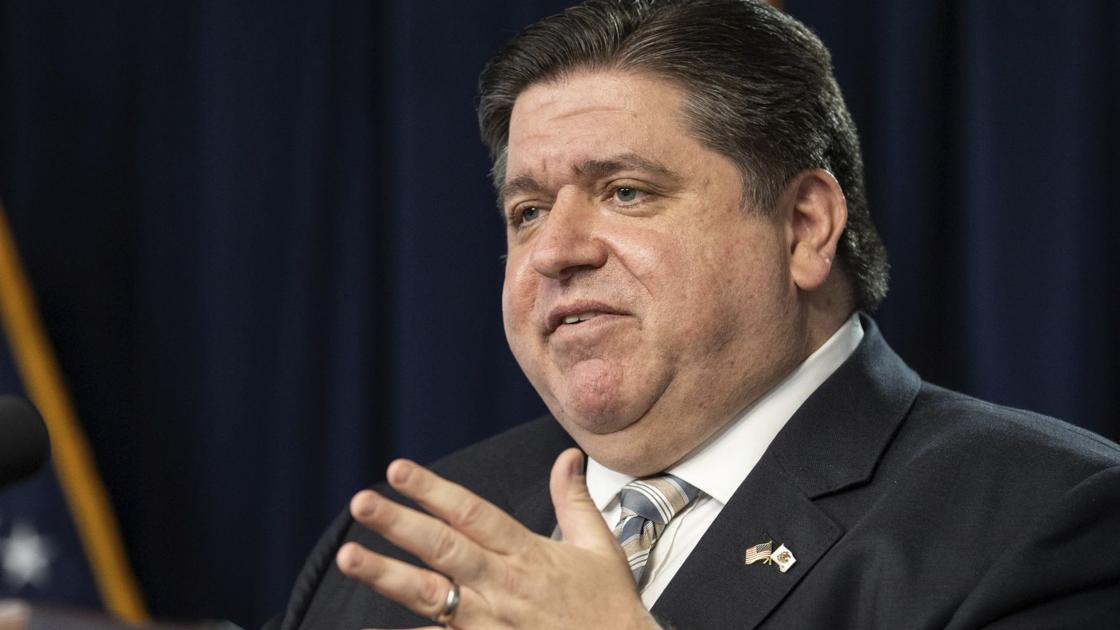
Illinois Gov. J.B. Pritzker responds to questions during a visit to Crossing Healthcare in Decatur on Wednesday, March 17. Pritzker was highlighting efforts to make vaccine access more equitable across the state.
One likely target is paying down the more than $3 billion the state borrowed from the Federal Reserve last year, a goal mentioned by both Gov. J.B. Pritzker and Comptroller Susana Mendoza.
Another likely target is the state’s massive bill backlog, which has increased to $5.66 billion. Pritzker also suggested in interviews with reporters that part of the money could go toward replacing lost revenue.
Illinois reopening plan: What to know about the latest updates
Increasing vaccine eligibility
Pritzker said all Illinois residents 16 and older would be eligible for the vaccine on April 12, ending the state’s phased-in priority distribution.
On that day, all state-supported mass vaccination sites, local health departments, pharmacy partners — every jurisdiction that receives vaccine from the state’s allocation — will be instructed to move to widespread eligibility.
Chicago has its own rules
Officials in Chicago might not follow the state’s lead on expanded vaccine eligibility April 12. The city gets its own pool of vaccine directly from the federal government and sets its own rules.
Mayor Lori Lightfoot said Wednesday that the city would expand the vaccine pool on March 29 to include people with additional health concerns and people in essential industries such as food service and construction. There’s no decision on when the city might open vaccination appointments to all.
‘Bridge’ to Phase 5
All of Illinois is currently in Phase 4 of the state’s reopening plan.
On Thursday, Pritzker introduced a new “bridge phase” for expanding capacity limits while remaining short of Phase 5, when the state will fully reopen.
This transitional period will start after 70% of residents 65 and over have received at least one dose of the vaccine. Pritzker said the state is now at 58% for that age group.
What happens during the bridge?
Under the bridge guidelines:
- Social events could be held with 250 people attending indoors or 500 people outdoors.
- Spectator events and theater productions could be held at 60% capacity.
- Meetings, conferences and conventions could be held at 60% capacity or 1,000 people, whichever is less.
- Zoos, museums and amusement parks could open at 60% capacity, up from the current 25%.
- For restaurants, standing areas would change from 25% capacity to 30% capacity indoors and 50% capacity outdoors. In seated areas, customers would still need to be seated 6 feet apart and in groups of 10 or less.
- Health and fitness facilities, retail stores, offices and personal care businesses would increase from 50% capacity to 60% capacity.
Click here for a full breakdown of bridge capacity changes.
Stricter conditions optional
All local governments, including Chicago, have the option of keeping stricter conditions than the state.
Pritzker said he hoped Chicago would follow the state’s guidance on reopening and move quickly to reduce restrictions.
Entering Phase 5
Normal business operations will be reintroduced during Phase 5 of the Restore Illinois plan.
This will begin after half of all residents 16 and older are vaccinated, and if there are no significant setbacks in terms of cases, hospitalizations or deaths after 28 days in the bridge program.
Currently, 28% of all residents 16 and older have had at least one dose of the vaccine, Pritzker said.
Pritzker would not guess at dates when the transitions might occur.
Masks remain mandatory
Pritzker said mask requirements will remain in place until the Centers for Disease Control and Prevention recommends lifting them.
“Masks have been one of our best ways to reduce risk in this pandemic and we won’t be foolish in throwing away our best weapon heading into the last lap of this fight,” he said.
The Chicago Tribune and Associated Press contributed.

Leave a Reply