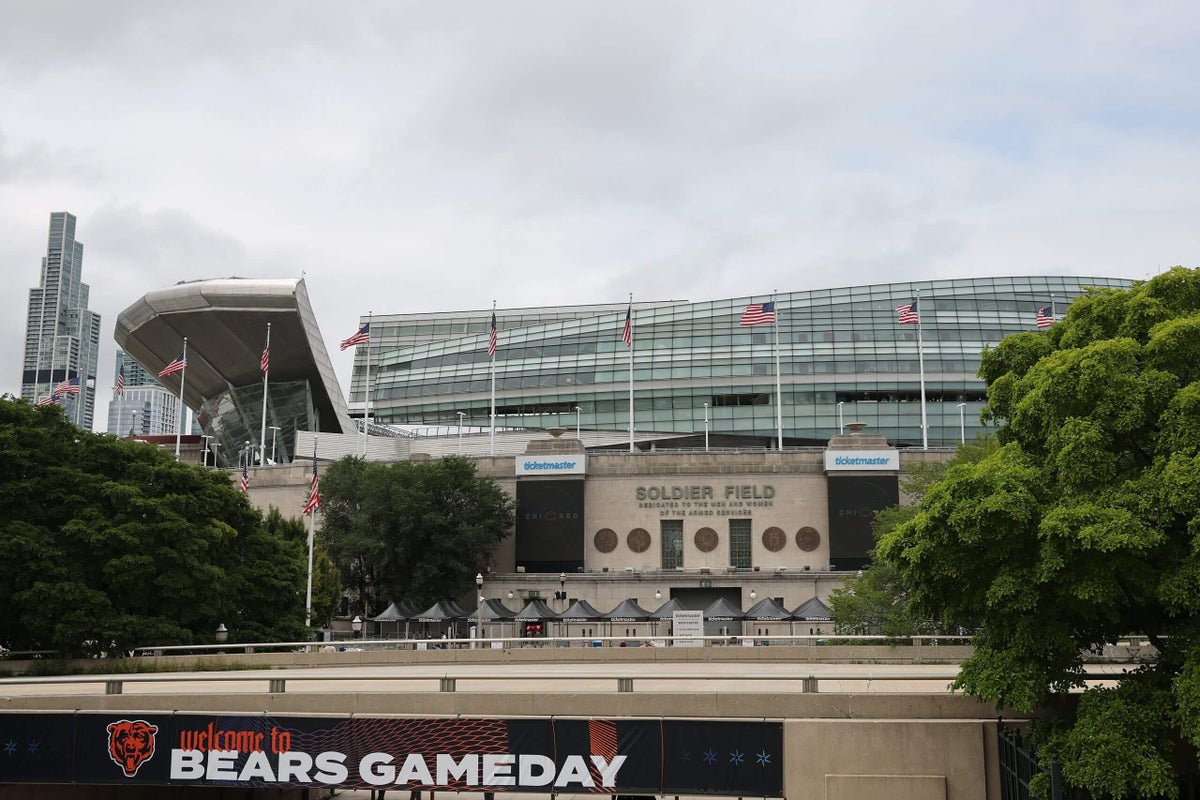
All the noise can feel disorienting, even deafening at times. Like a truckload of pots and pans dropped from an airplane and landing atop a grand piano warehouse. That’s what happens when confusion overpowers clarity within a politically charged ordeal and when lawmakers then mobilize to explain the chaos.
Dateline: Chicago, where the ruckus may only grow louder in the coming weeks.
On Friday morning — barely four days after the Chicago Bears’ pursuit of a new stadium in Illinois hit its latest dead end with the state’s spring legislative session adjourning without a solution — the team escalated its flirtation with a potential move to Indiana.
Through a formal vote by the team’s board of directors and a 74-word joint statement from Chairman George McCaskey and President and CEO Kevin Warren, the Bears stated their intent to “advance our stadium development project in Hammond,” bringing last week’s clatter to a crescendo. Ultimately, a question that has circulated since December was suddenly being shouted at ear-splitting volumes.
Are the Bears really and truly going to move to Hammond, Indiana?!
The simplest answer from those who have been connected to or have followed this saga for years: Hard to know definitively yet, but it’s impossible to say ‘no.’
At present, the Hammond possibility has more momentum than ever. It’s not a done deal. But this is not an idle threat from the Bears either. And these latest developments have prompted heightened curiosity.
Will Illinois politicians be willing to fight to avoid losing the Bears to Indiana? If so, how hard? And how quickly and decisively can they act as the team, seemingly unwilling to sit as a patient observer for much longer, pivots toward a realistic Plan B in Hammond?
That’s what these coming weeks in Illinois will be about with government leaders — Speaker of the House Chris Welch, Senate President Don Harmon and Gov. J.B. Pritzker among them — needing to determine whether they can unify around a clear stadium solution for the Bears and do so quickly enough to slow the team’s march toward the border.
On Friday, a statement from Pritzker’s office indicated the governor “wants the Bears to stay in Illinois and remains open to a sensible solution that protects taxpayers.”
Harmon expressed his feelings that the Bears’ latest declaration did not include a closing door. “We are ready and willing to re-engage with the Chicago Bears when they realize Illinois will always be the best place for them,” he said.
Welch, meanwhile, emphasized that he remained “open to ongoing efforts to secure the Bears in Illinois.”
“However,” he added, “it will take time to get it right.”
But how much time is necessary? And when might Illinois lawmakers re-engage in a serious manner?
Suddenly, Season 5 of this prolonged, confounding stadium soap opera has rolled its credits with a familiar final message: To be continued …
Since the December introduction of Hammond as a potential site for a future Bears stadium, the team has applied pressure to Illinois lawmakers to pass legislation that would get the franchise’s long-hoped-for project in Arlington Heights launched.
In spurts, that has worked. With Indiana competition lurking, discussions and negotiations on the Bears’ stadium inside the Illinois General Assembly were more frequent and substantive during this past legislative session than they had previously been.
(The ease with which the Indiana legislature passed a Bears-favored bill this winter for a potential new stadium enhanced the team’s leverage also.)
Still, Friday’s statement from McCaskey and Warren seemed to create the loudest reaction yet among residents, fans and politicians.
Rep. Kam Buckner, who had sponsored a Bears-centric megaprojects bill that passed through the Illinois House of Representatives in April but collapsed in the Senate on the final weekend of May, didn’t seem fazed by the Bears’ statement and said his call with Warren on Friday morning included the team president’s commitment to “continue discussions around their pursuit of a new stadium in Illinois.”
Added Buckner: “Neither the statement nor my conversation with Kevin suggested that Illinois is off the table. In fact, our discussion was forward-looking and centered on continuing conversations.”
Eventually, though, conversations must spark action. One way or the other. And that action will ultimately propel this across a finish line. In one state or another.
So who should be trusted to now take the wheel? Amid all this indecision and turbulence, who should call the next shots or devise the next plan? Illinois and Chicago-based politicians? Bears leadership? The government leaders in Indiana?
Many things have become crystal clear over the last several years — and specifically in recent weeks. First and foremost, almost no one involved in the quest to keep the Bears playing in Illinois has been united, just a bunch of independent parties running haphazardly in different directions. As a result, much of the problem-solving process has been defined by disconnect and dysfunction.
Chicago mayor Brandon Johnson and Pritzker consistently seem to be at odds.
The Bears and state lawmakers have not only been on different pages too frequently, they seem to be visiting different libraries altogether.
And in Springfield, members of the Illinois Senate and House of Representatives seem to have lost the art of compromise, of working in tandem to find a sensible path forward.
(Interestingly, both chambers passed pieces of legislation they asserted would help the Bears with their stadium efforts. But they were separate bills altogether. And each chamber of the General Assembly seemed more aggravated than enthused by what the other dropped in its lap.)
Last week, before the team’s seismic statement was released, a whole lot of chatter mushroomed as countless politicians from Illinois and Indiana plus a handful of statehouse reporters found platforms to offer explanations for why everything remains so disorderly.
Among the assertions that bounced through the discourse:
— The Bears, with Warren setting their direction, have been clumsy at best with their maneuvering through Springfield, perhaps slipshod with their strategies in Illinois and, at times, averse to advice from their own lobbyists. That, lawmakers within the General Assembly have insinuated, has impeded the team’s ability to create meaningful momentum.
— There remains minimal interest from many Illinois lawmakers in granting a massive tax break to a well-off NFL team — though a last-minute act introduced and passed by the senate on the first morning of June somehow would’ve taken the Bears off the hook for property taxes on their next stadium altogether.
— Indiana, with legislation passed in February, has at least begun paving a road — figuratively only, of course — for the Bears to come across the border if their exploration of the Hammond project genuinely proves compelling.
Indiana’s approval for a new stadium authority promises tax subsidies that have already proven financially attractive to the Bears and could propel that project forward if everything else checks out. But as the team moves in that direction, they’re seemingly doing so with ears open and one eye peeking back to detect what Illinois leaders might come up with as a counter.
Over time, the message delivered from Illinois legislators hasn’t been subtle. The Bears, lawmakers continue to emphasize, just aren’t a priority. There are much bigger fish to fry, they have contended. And there has been little to no interest in moving heaven and earth to assist a professional sports franchise amid current significant constituent concerns about other pressing issues inside of an uncertain economic climate with the costs of everyday living escalating.
Honestly, all fair enough. But why then, when the most feasible alternative may be for the Bears to bolt for Hammond, do many Illinois politicians often react much differently?
Whoa! Whoa! Let’s talk about all this. Give us a little more time to help figure this out. Can we at least have the first part of the summer to think and propose a solution?
Through words alone, few Illinois lawmakers have been emboldened enough to shoo the Bears with an emphatic “Good riddance!” salutation.
By the same token, though, it remains fair to wonder whether state politicians as a collective have serious intent about helping the Bears stay in Illinois or whether adopting a “We tried” posture is part of the ultimate goal.
Nearly five years after the Bears first bid on the 326-acre property in Arlington Heights — where Arlington Park racetrack previously resided — the whole stadium plan in that suburb suddenly feels closer to the starting gate than the finish line.
In a saga this complicated and layered, it’s possible no one has answers for what option — new or old — makes the most sense now. Not even the Bears, who have embraced a vision for a stadium and grand multi-use district in Arlington Heights. But the team hasn’t been able to obtain desired financial support from within the Illinois General Assembly to bring that dream to life.
Even with the Bears pledging $2 billion of private funding toward stadium construction — with another $300 million in G5 funding from the NFL likely — the team’s requests for tax certainty and state-driven infrastructure aid have yet to be granted.
It’s notable now to think back on Warren’s introductory news conference at Halas Hall in January 2023. For those counting: 1,238 days ago. At the time, Warren projected confidence in how he’d guide the Bears, certain his presence inside the Minnesota Vikings’ organization during that franchise’s new stadium journey last decade could provide a valuable compass.
“I had all these boxes of binders,” Warren said then, “and many people said, ‘You can get rid of those, you’ll never use those again.’ I’m glad I saved them.”
His insinuation was that pieces of the Vikings’ process could become significant catalysts for the Bears’ stadium efforts. Alas, the playbook that worked in Minnesota hasn’t yet produced results in Illinois.
Warren also emphasized at that time his desire to establish “the why” of this new stadium project for absolutely everyone it would involve. “No matter what constituent group you put in front of me, what’s the why?” he said. “The more common the why you have, the more people will understand.
“It’s like winning a championship. I’ve never met a person who you meet and say, ‘Do you want to be a champion?’ And they go, ‘No, I don’t want to be a champion.’ They say, ‘Of course, I want to be a champion.’ The question becomes, ‘Can you put in the work to do it?’ With stadium development projects — and one of the many things I learned in Minnesota — you have to create a compelling story of why it makes sense.”

CEO Kevin Warren and the Chicago Bears’ board of directors released a 74-word joint statement stating their intent to “advance our stadium development project in Hammond.” (Michael Reaves / Getty Images)
Part of Warren’s story was that a new Bears stadium would create jobs — 56,000 for construction, he said last summer, and more than 9,000 permanent jobs. Even with a requested tax break, the Bears were still readying to pay more taxes than had ever been paid on that Arlington Heights property, creating new revenue streams for the community, the county, the state. And, before the megaprojects bill failed, the team felt confident in the support it had within Arlington Heights and the immediate surrounding suburbs.
But Chicago-based politicians have had heightened resistance and reactions to the idea of the team moving its home games out of the city — even if the Bears and the NFL have repeatedly said that’s a fait accompli.
At this point, there seem to be many more questions than answers. With the volume of a ticking clock adding to the clatter.
Eventually, conclusions must be drawn and decisions made. And the Bears assert that time is of the essence. So what now? And what’s next?


Leave a Reply