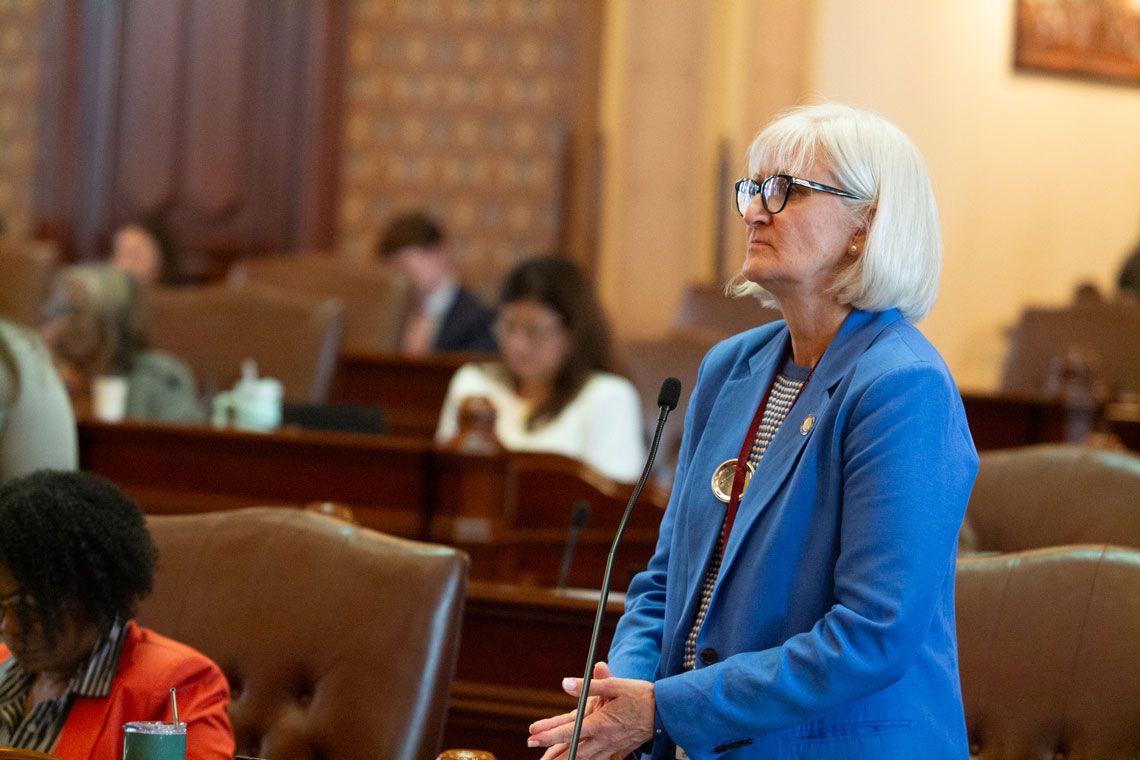
The Illinois Senate voted overwhelmingly on Thursday to advance a bill that would regulate how large artificial intelligence model developers handle transparency and catastrophic risk.
Senate Bill 315 is part of an eight-bill package and is modeled after similar legislation in New York and California as lawmakers, at the urging of industry lobbyists, seek to establish a “de facto” national AI standard.
Announced on May 13, the bill would require large developers like Meta, OpenAI and Anthropic to adopt a transparency framework, employ third-party auditors and report a model’s catastrophic risk capabilities. It passed the Senate 52-5.
The move comes as President Donald Trump recently floated the possibility of a second AI-related executive order, this time directing developers on how to report powerful models to federal officials. Trump previously issued an order discouraging states from regulation, but state lawmakers cited a lack of federal movement as their reason for moving forward with regulations.
State Sen. Mary Edly-Allen’s bill is functionally the same as California’s and New York’s laws, which both passed in late 2025. It would require large developers with revenues over $500 million — a threshold tailored to capture only the largest entities — to create, publish and adhere to a transparency framework explaining how the company applies industry standards, measures model capabilities and chance of catastrophic risk, and identifies and responds to safety incidents.
Three of the leading “frontier” AI companies — a term used in the bill to describe the large, groundbreaking tech companies — have reported in their own safety evaluations that their models could provide meaningful assistance in building a biological weapon, according to the testimony of Scott Wisor, policy director for Secure AI, a nonprofit seeking meaningful AI regulations.
Anthropic’s Mythos, for example, is so powerful the company said it could not release it to the public.
OpenAI and Anthropic both testified in support, with OpenAI again citing the effort to create a national standard focused on the “most capable” models and the worst potential harms. That approach allows smaller companies to thrive and continue innovating, while still protecting consumers. Other advocates, from startup coalitions to transparency-oriented nonprofits, say the bill is only the beginning of the conversation.
“It’s important to keep perspective about how modest many of these requirements still are relative to the scale of the technology involved,” said Jonathan Iwry, a fellow at the Wharton Accountable AI Lab at the University of Pennsylvania, in an email to Capitol News Illinois. The lab researches ethical, regulatory and governance considerations for AI.
“Even the companies developing them seem unable to reliably predict or control the systems’ behavior,” Iwry said. “Against that backdrop, requirements like transparency, testing and auditing should probably be understood as foundational safeguards rather than the upper limit of accountability.”
Bill debates
Edly-Allen’s bill, while shaped similarly to California and New York, does go farther by requiring third-party auditing. The audits are meant to ensure compliance, Edly-Allen said. But the provision became a point of contention in committee.
For Jeremy Kudon, executive director of the American Innovators Network, the audits represent an “expensive requirement” for startups with few, or even no, lawyers on staff. AIN is a coalition of startups and small-sized AI companies.
“They’re gonna have to rely and use their much-needed capital to pay for lawyers and … lobbyists simply to comply with these laws, when their whole goal is to help innovate and to make AI, you know, more accessible to everyone,” Kudon said.
Kudon and other advocates also expressed concern that this kind of tweaking could throw off the national standard companies are seeking.
“This kind of violates the principle that we set out at the very beginning … that we would have three states all following the same framework in this really initial year of AI frontier model legislation,” Kudon said.
Senate Republican Leader John Curran on May 13 questioned whether the bill was clear enough regarding the auditing process.




Leave a Reply