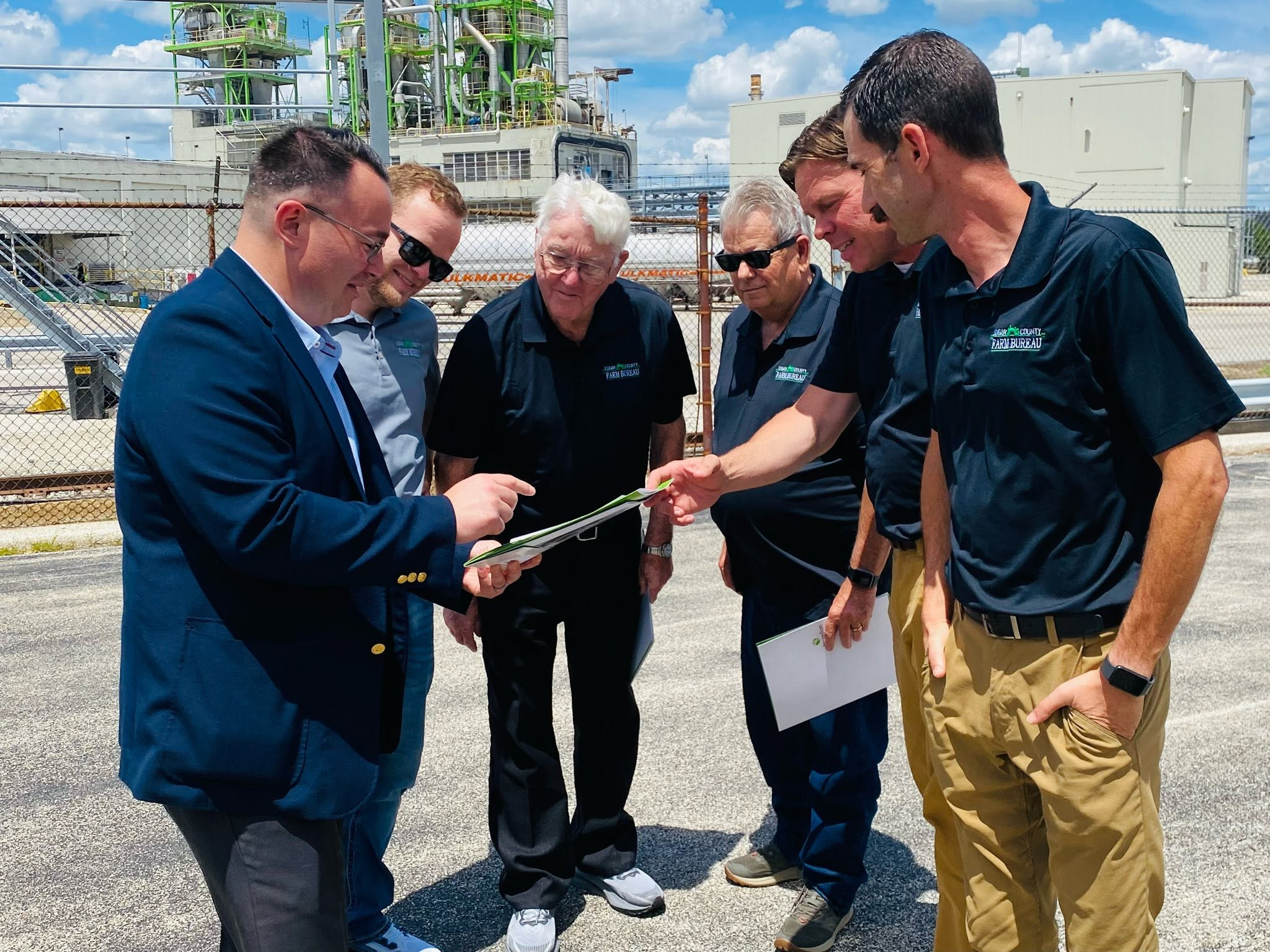
State Senator Mike Porfirio welcomed members of the Edgar County Farm Bureau to Illinois’ 11th Legislative District this week, part of a statewide effort to build understanding between urban lawmakers and rural farmers—and to show how deeply agriculture shapes the Chicago economy.
The visit included stops at Porfirio’s district office in Burbank, the Frito Lay Distribution Center in Summit, and Ingredion in Bedford Park, facilities that illustrate the economic ties between downstate crop production and urban food processing and distribution.
“Visits like these are crucial to bridging connections between the farmers that support production and the food distributors in our district,” Porfirio (D-11th Dist.) said. “Our economies and communities are closely intertwined and I look forward continuing this exceptional partnership.”
Wyatt Williamson, manager of the Edgar County Farm Bureau, said the connection runs deeper than most urban residents realize.
“Everybody eats, right? So when you think about it, it becomes pretty imperative that we have agriculture,” Williamson said. “And believe it or not, the number one industry in the state of Illinois is, in fact, agriculture.”
Illinois is not just an agricultural state; it is a Chicago-dependent agricultural state. The state’s largest city and its suburbs depend on corn, soybeans, beef, and pork from downstate. In return, rural farmers depend on Chicago’s commodity exchanges, food processors, and distribution networks.
“The Chicago Mercantile Exchange is where crops and animals are traded across the stock exchange,” Williamson said. “My grandfather grew up taking loads of livestock up to the stockyards back when that was still around. So it’s intertwined, the state between the city and the rural in terms of agriculture; that’s very circular economy.”
The Edgar County Farm Bureau’s visit to Ingredion in Bedford Park revealed the scope of that connection. The facility takes raw corn from farmers across the region and transforms it into ingredients used in everyday consumer products—starches and gums that thicken and stabilize foods, sweeteners, and plant-based proteins.
“The amount of different products and things that they can do with a single kernel of corn is absolutely fascinating,” Williamson said.
Ingredion has been a staple in the 11th district for decades, he said. “It’s quite the sight to see, for sure.”
Illinois agriculture extends far beyond corn and soybeans. The state is the nation’s top producer of horseradish, grown in Madison County near St. Louis. Illinois also produces significant quantities of green beans on the state’s west side near the Illinois River and pumpkins in Tazewell County—crops that reach consumers from the city to the suburbs to rural areas.
Modern Farming Today.
When Porfirio visited Edgar County, Williamson showed him the hidden complexity of modern farming. The senator toured a seed business run by one of the Edgar County Farm Bureau’s presidents, watching how soybean seeds are treated with fungicides and prepared for planting. Then he climbed into a tractor with the president’s father-in-law and rode along as a field was planted.
“He got to run the tractor,” Williamson said. “A lot of it is automated GPS, but you still have to get things lined up. I don’t know if he knew what he was in for quite that day, but he got to plant his first ever soybean crop.”
The Edgar County Farm Bureau plans to bring Porfirio back in the fall to ride in a combine during harvest and visit a grain elevator—next steps in showing him the full scope of agricultural operations.
What some urban people may not understand, Williamson said, is that farming today is high-tech, science-based work that demands constant learning, adaptation, business acumen and more.
“You have to be a jack of all trades at all times, basically,” he said. “You have to be your own marketer. You have to be your own buyer of your supplies and keep your budget, and you have to be your own weatherman sometimes. You got to be your own mechanic sometimes.”
The current farm economy makes those demands even heavier. Prices for crops are low while input costs—seed, fertilizer, chemicals, equipment repairs, and cash rent—remain high.
Farmers’ mental health has become a critical issue, Williamson said. Taking product across the scale at the grain elevator is not equating well currently.
“In these tough times, you even sometimes have to be your own therapist or your neighbor down the road’s therapist because there is an attachment to the land and a pride in growing a crop each and every year to live off of, and for your family, that if things start to go sideways, the mental health aspect has been a huge impact,” he said.
The Illinois Farm Bureau and county bureaus are working to offer resources and support with the establishment of a farmer mental health hotline by the Southern Illinois Farm Bureau.
“On top of all those other jobs that come in each and every day, you’ve got to make sure you’re okay in between the ears,” he said.
The stakes are particularly high now because 96% of Illinois farms are family-owned, and a generational shift in land ownership is underway. As older farmers retire, their heirs often face crushing estate taxes that force the sale of family land.
That reality brought the Edgar County Farm Bureau to Porfirio with a specific legislative priority: the Family Farm Preservation Act. The current state estate tax threshold is $4 million—far below the federal threshold of about $15 million. For a family inheriting 80 acres of farmland plus equipment, that $4 million threshold disappears quickly.
“If you start doing the math on what 80 acres goes for these days, when it’s inherited from your grandfather or your father, your family, you can eat up $4 million in a blink of an eye without even getting into the equipment,” Williamson said. “Then you’re going, ‘Oh, shoot. I have to sell half of the farmland that’s been in my family for 100 plus years just to cover the tax bill that’s due.’”
When family farms are sold to cover estate taxes, they often go to corporations or outside investors rather than neighboring farmers. The result is the loss of family operations that have anchored rural communities for generations.
“That is a number one priority for Illinois Farm Bureau is to help get that Farm Family Preservation Act across the goal line and move up that threshold more in line with the federal threshold,” Williamson said.
The Edgar County Farm Bureau hopes this legislative session is the one that gets it across the finish line.
The Edgar County Farm Bureau’s annual visit to the 11th District is part of the Illinois Farm Bureau’s Adopt-A-Legislator Program, launched in 2001 to build long-term relationships between urban state lawmakers and farmers. County farm bureaus have adopted 73 urban legislators statewide.
Nearly every Cook County legislator now participates increasing personal relationships, increasing visibility and involvement in agricultural issues that come before Illinois’ General Assembly.
“We truly, truly enjoy coming up every single year we’ve done it,” Williamson said. “It’s imperative to our organization and to the Illinois Farm Bureau to bridge these gaps between the rural and urban parts of Illinois and show that we’re all trying to pull on the same end of the same rope here.”
To learn about agriculture in Cook Cty., go to: https://cookcfb.org/

Leave a Reply