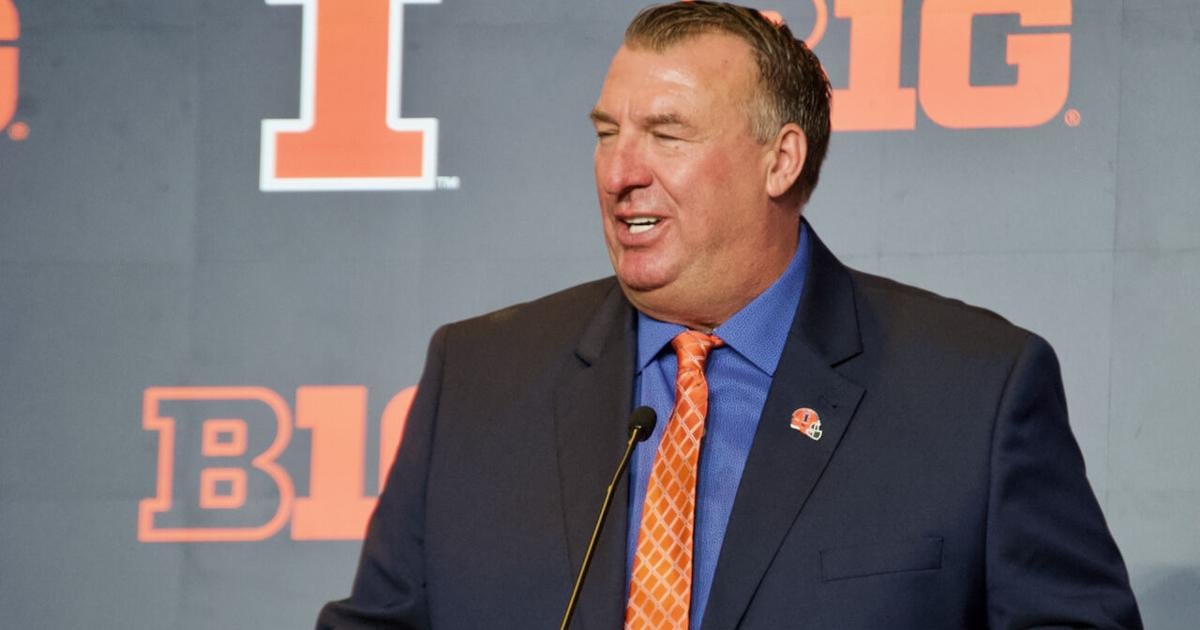
CHICAGO — Bret Bielema is savvy enough to realize when he slid a comment into his opening statement late Tuesday morning at the Chicago Hilton about the SEC’s desire to “want to live in 2005 forever” that it wouldn’t go unnoticed.
It didn’t.
Bielema was asked to clarify and explain what he meant during the Q&A portion of his time at the podium, broadcast live on Big Ten Network, at Big Ten Media Days
“Well, I think I just made the headline, right?” the Illinois football coach quipped.
Bielema has consistently expressed an opinion that college football in its current state is the best version of the sport. That heading into his 18th season as a head coach, with stops at Wisconsin and Arkansas before he landed at Illinois in December 2020, he has a level of excitement for what’s possible in Champaign, throughout the Big Ten and across the entire college football landscape.
Mostly because it’s not 2005 anymore.
“Revenue share or NIL, however you want to describe it, when those two elements came into college football, the whole world changed,” Bielema said. “I mean, it’s overly obvious to say that, but I think anything to predate that is just a different time in college football. It just is.”
★ ★ ★
What Bielema finds beneficial about the seismic shift in the sport created by an open transfer portal and the ability for athletes to share in revenue and take advantage of their name, image and likeness is the ability to fight against the inertia of what was college football history.
The Illinois coach likened the current state of the sport to his recruitment of Hjalte Froholdt at Arkansas. The Danish lineman visited Alabama, Florida, Ohio State and Michigan before winding up in Fayetteville, Ark., where he ultimately turned into a fourth-round NFL draft pick after his time with the Razorbacks who now in his seventh season in the league.
“We hadn’t won anything at that point,” Bielema said. “He came to Arkansas, in my opinion, because he wasn’t blinded by the 50 years that he didn’t know, or the 18 years he had been alive on this Earth, because he had been in Denmark. He wasn’t blinded by the things that he had been told or learned.
“It’s a different world. The quarterback I have now, we would not have gotten … five years ago. I know that. Neither would my left tackle. My left guard, my center and my right tackle wouldn’t be here playing for me. You go around to every team, and the rosters have changed because of those two components. The transfer rule and revenue share. It’s a different world. Anything beyond that is nonsense. That’s where I’m coming from.”
★ ★ ★
Not every Big Ten coach shares Bielema’s idea that college football has never been in a better place. Like his old boss, Iowa coach Kirk Ferentz, who said Tuesday he is concerned about how the transfer portal, NIL and the singular emphasis on the 12-team College Football Playoff has changed the sport.
Ferentz’s greatest concern comes in the mostly unregulated nature of both the transfer system and how athletes are compensated.
“I kind of prefer to work with boundaries with a system, a system in place,” the longtime Iowa coach said. The 70-year-old Ferentz is the longest-tenured FBS coach in the country now entering his 28th season with the Hawkeyes.
“Spent six years in the NFL,” Ferentz continued. “I really don’t have any aspirations of ever going back there. Haven’t since I left. I’ve enjoyed every job I’ve ever had, but two things I really appreciate about the NFL — contracts are contracts, they mean something, and there’s a salary cap. In the NFL, another thing is equal enforcement. All rules get enforced the same ways. You have 32 teams operating in the same system, same set of circumstances and rules. It really gets down to the players and the coaches. Imagine that.”
★ ★ ★
Big Ten Commissioner Tony Petitti answered nearly two dozen questions Tuesday morning. He noted he cut his opening statement short — on advice of new Big Ten senior vice president David Bassity — to get in as many questions as possible.
Where Petitti couldn’t be dragged, however, was into any answer comparing the relative strength of the Big Ten and SEC. That the podium he and all six Big Ten coaches who spoke Tuesday was situated next to a table that held the last three College Football Championship trophies was all the answer Petitti needed to how his league compared to the SEC.
Where Petitti did stand up for the Big Ten was against the idea the conference was top heavy and not as deep as its primary rival.
“You cannot send your top teams out into the CFP — and have them be successful, which we have been very successful — if they’re not going through a gauntlet in the regular season,” he said. “This idea that the middle of our conference isn’t hard is just not right. At the end of the day, our teams are ready for the CFP. Our travel looks like the CFP travel. You’re going all over the country.
“I just think that’s overlooked. The reason why we’ve been so successful is our teams are prepared. The best teams in any given season play each other. That’s great. That prepares them. But you also get through a lot of really difficult games. You can’t be ready to go play in the postseason after you think you’ve played something easy. It just doesn’t happen. It’s something that gets overlooked in our league. We have a difficult league. It’s tough to win on the road in the Big Ten for even the best teams.”
★ ★ ★
The turnaround between Illinois’ stint in Chicago for Big Ten Media Days and the start of training camp is short. The Illini will open their fall camp on Monday and will do so relatively healthy.
Bielema didn’t give specifics on Tuesday, so not to miss a name, but said five players, not on the two-deep, would miss the entire 2026 season for medical reasons.
“We’re going to have a couple guys that might be a little slow to return to camp, but by the time we get to fall camp, we should be pretty healthy,” Bielema said, adding the only lingering issues are some soft-tissue injuries. “Nobody had anything catastrophic since the spring.”
The structure of Illinois’ training camp will also be different. Bielema has regularly sent his first-team offense against his first-team defense the first two weeks of camp. That won’t be the case starting next week. Mainly because of the new 3-3-5 scheme new Illini defensive coordinator Bobby Hauck is expected to unveil this season.
“Our defense is such a unique prep, and I don’t want to waste our offensive time by planning and scheming against something they’re not really going to see,” Bielema said. “We’ll do a lot more regimented look team stuff going against the teams we’re going to see early. Defensively, we concentrated in the spring on early downs and third down. Now, we’ll start getting really into football situations — end of half, end of game. Situational football, which is something we’ve been really good at.”
★ ★ ★
The public debut of Illinois’ massive new video board at Gies Memorial Stadium is set for Aug. 8 with a 7 p.m. showing of “Air Bud.”
Josh Whitman will be there with his wife, Hope, and their two children, Tate and Will. The Illinois athletic director said he wouldn’t miss seeing Illinois sophomore forward David Mirkovic’s favorite movie.
Whitman has had something of a front-row seat to the video board’s ongoing construction. The floor-to-ceiling windows in his office at Bielfeldt Athletics Administration Building have provided the perfect venue to watch the largest video board in all of college football be built.
“It’s been fun to watch it come up out of the ground,” Whitman said. “The steel went up quickly, and then the video elements got done even faster. It’s really come together in a relatively short amount of time. We have all the connections made now, so the staff is working every day to learn it, calibrate it and do a bunch of things I don’t understand.”
Whitman got a look at the new video board from the Gies Memorial Stadium press box on Monday. That vantage point gave him a different perspective on the video board’s size at just more than 17,300 square feet. The sheer size of it is even more apparent from inside the stadium.
“It really closes off that end of the building nicely, which is something I hadn’t really thought about, to be honest,” Whitman added. “Just the physical element of it. It makes the building feel a little tighter. I’ll be curious to see what it does for wind, what it does for sound in terms of fan noise. I won’t be surprised at all if it holds things in a little more.”
Scott Richey
Scott Richey covers college basketball for The News-Gazette. His email is srichey@news-gazette.com, and you can follow him on Twitter (@srrichey).



Leave a Reply