CHAMPAIGN — Bret Bielema ran into Melvin Gordon last week in Chicago at Big Ten media days.
The Illinois football coach couldn’t help but reminisce about the Wisconsin teams he coached with Gordon a go-to option in the run game. It didn’t start out that way, of course.
Gordon might have stacked up award after award in 2014 when he led the nation in rushing with a staggering 2,587 yards, but the eventual Pro Bowl running back and Super Bowl champion started his Wisconsin career fourth on the Badgers’ depth chart at running back.
That was the team Bielema thought of first when he crossed paths with Gordon at the Hilton Chicago. The running back room that included Montee Ball, James White and Jeffrey Lewis in addition to Gordon.
“I’m not saying we’re quite there, but I do think our running back room is getting close to what we had going some other places,” Bielema said about the collection of running backs he has this season in Champaign.
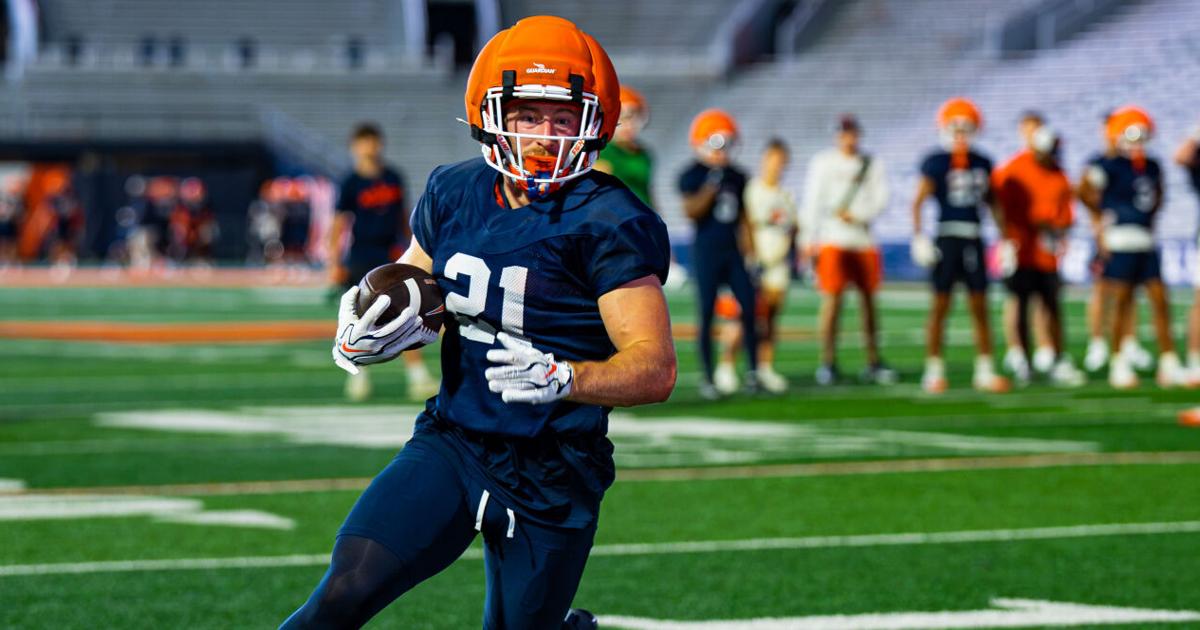
Leading rusher Ca’Lil Valentine is back this fall for Illinois. So is fifth-year back Aidan Laughery. Those two project to receive the bulk of the snaps in 2026, with Kaden Feagin, last year’s second-leading rusher, moving to tight end.
Jordan Anderson completed the Feagin trade, moving back to running back from tight end, and gives Illinois an experienced trio. A group of veteran backs bolstered by sophomores John Forster and Cedric Wyche II and freshmen Javari Barnett and Nelsyn Wheeler.
Wheeler turned some heads this spring after enrolling early. Barnett, who Illinois flipped from Alabama and didn’t arrive until summer, could give the Illini a big back with speed at 6-foot-1, 210 pounds with a 100- and 200-meter dash sprinter background.
“We don’t lack talent,” Laughery said. “Those guys need seasoned a little bit — they’re raw — but they’re making steps every day. I’ve been impressed with them so far.”
Laughery has also impressed new Illinois running backs coach Tyrone Wheatley. The former Michigan star and 10-year NFL pro replaced Thad Ward in February after Ward left for Kansas State.
Wheatley is the third running backs coach Laughery has played for during his five seasons at Illinois, following Ward and Cory Patterson. That collection of coaches has helped shape the former Gibson City-Melvin-Sibley standout into a Big Ten-caliber back.
“It’s funny, being a younger guy, you’re trying to put it all together,” Laughery said. “At this point, I’ve had three different coaches. It’s good when you know the offense, you know the scheme. You don’t really have to take steps backward. You can apply things a new coach brings in and hear things from a different perspective, and that’s always good.”
Training camp marked the first time Wheatley has had his entire group on the field together since Barnett’s summer arrival. What he learned during the spring and has only been reinforced in the lead-up to camp and a few practices is how Illinois’ running backs can mix their competitive edge and their ability to get along and help each other.
“Every room in this building is competitive, but I have some, oh my goodness, extra competitive, overly competitive guys,” Wheatley said. “I’m not trying to paint no kumbaya moments, but it’s a great deal when I go in that room, sit down and see them collaborate and talk.”
Wheatley’s focus is simple after training camp started Monday. The first week is all about the offense as a whole. He knows he has different running backs suitable for different roles, but how they fit in the offense at large comes first.
“If you don’t do a particular skill set very well, don’t sit here and say, ‘Well, I can’t do that. That’s not for me,’” Wheatley said. “It’s not about you right now. As we get going with the playbook and as install’s going and it starts to grow, we’ll figure out what’s for you, but right now, it’s about the offense and about the team. That’s it. That’s my expectation for the first week.”
Barry Lunney Jr.’s expectation is Illinois continues to run the ball. It’s a pivotal piece to the offense, with any RPO, play-action or quick game calls built on the back of an effective run game. Statistics don’t matter as much to the Illini’s offensive coordinator as what the run game looks like functionally.
“Can we run the ball when we need to run the ball?” Lunney said. “Obviously, when you have a good running day, it shows up in the box score and everybody can see that. There’s days we ran the ball well in this league, and the statistical part has not moved the needle as much as you would want to the naked eye, but, yet, we’ve done enough in the trenches to establish the line of scrimmage, to be good on short yardage.
“I felt good about what we accomplished in the spring. Ultimately, we’ve got to go put that to work when it comes to the season and the 12 games. We’ve got to be able to run the football in this league. If you can’t run the football in this league, you’re going to perish.”
Scott Richey covers college basketball for The News-Gazette. His email is srichey@news-gazette.com, and you can follow him on Twitter (@srrichey).


Leave a Reply