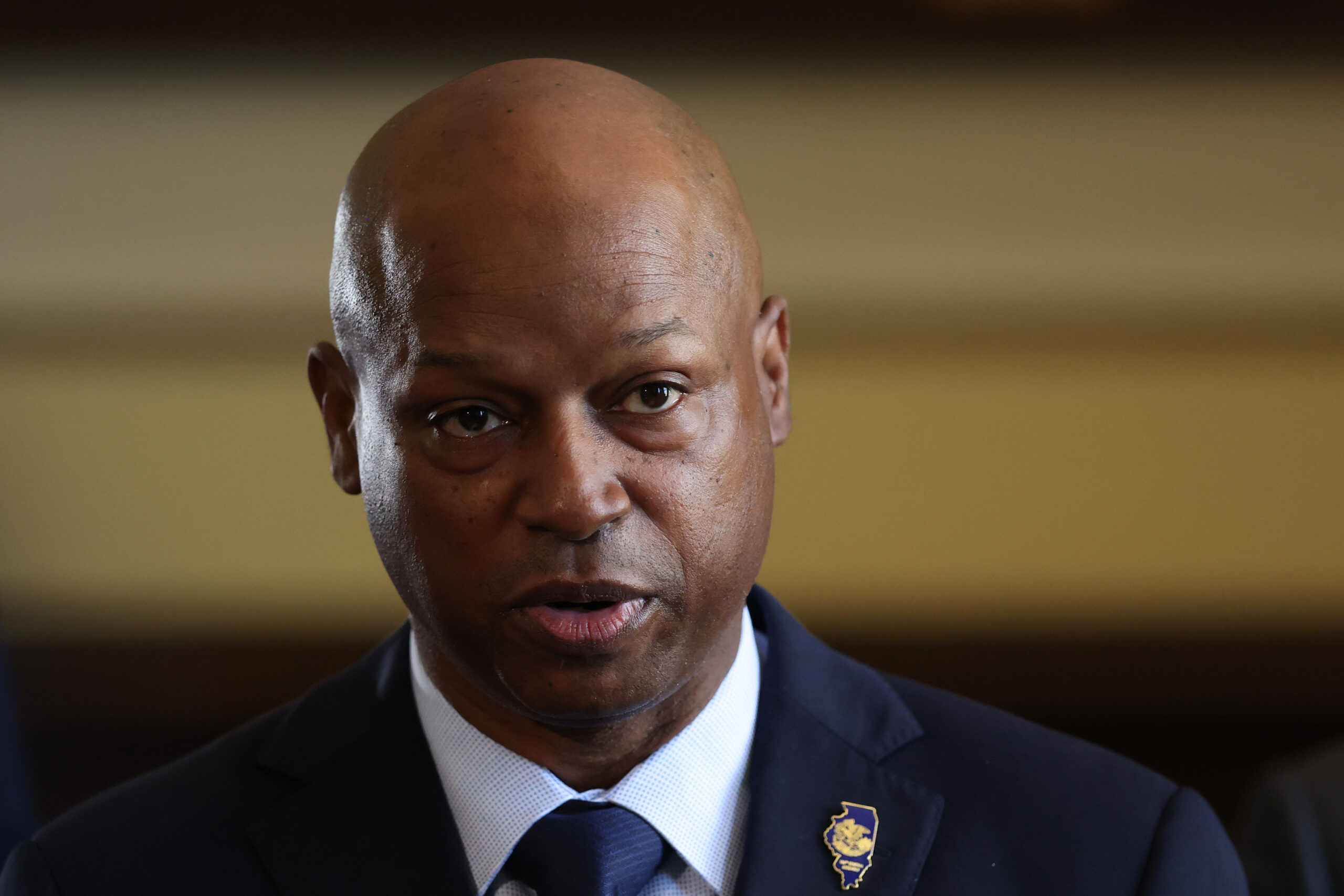
State inaction on now-former Rep. Harry Benton and Illinois House Speaker Emanuel “Chris” Welch not only delaying doing anything about the allegations against Benton but also supporting his reelection with lots of financial support are business as usual in Springfield.
Current issues with Benton and Welch and the culture of Springfield deserve the voters’ attention. Will this ever stop?
Welch said: “If there are gaps in our policies, our laws, or our workplace practices, then it is our duty to close them.” Is he serious about “if”?
Finally, Welch seems to be doing something about the bad actors in Springfield, but as far as I’m concerned, it’s too late and probably too little. A first step in Springfield is to choose leaders who will act quickly and aggressively. Welch is an example of not doing what has needed to be done for a very long time.
He must go!
— Richard Prince, Chicago
Handling of allegations
In response to the reporting on sexual harassment allegations against now-former state Rep. Harry Benton and the handling by the office of House Speaker Emanuel “Chris” Welch, I’m amazed at the explanation that “the Chief of Staff and the Ethics Officer for the Speaker’s Office decided to confront Benton with these allegations after the (victim) resigned in June 2023 to avoid retaliation by Benton.”
I am an officer for a big city fire department, and our policy for sexual harassment allegations is to go directly to the Equal Employment Opportunity Commission. I am not to initiate an investigation or even go up the chain of command. Our policy and procedure have us call the EEOC liaison immediately.
I find it hard to believe that the speaker’s office’s policy on sexual harassment allegations is to handle them in-house on a timeline that it feels is appropriate. Welch’s handling of this is not what would be expected of any employer. I would be fired for acting in this manner.
Being as politically corrupt as Illinois is, I am sure in a few months, the Illinois legislature will move on with promises of ethics reform, which, in Illinois, never happens.
— Raymond J. Fineron, Chicago
Michael Madigan redux
Illinois House Speaker Emanuel “Chris” Welch spent $1.4 million to help now-former Rep. Harry Benton get reelected a year after sexual harassment allegations against Benton were brought to his attention.
Meet the new boss — same as the old boss.
— Thomas Bober, Hinsdale
Transit ‘bailout’ a misnomer
Regarding the editorial “Public disservice announcement — beginning Saturday, Chicagoans will pay $1.50 on every $10 in retail purchases” (July 31): There is no such thing as a “transit bailout.” Public transit is an essential utility that is not required to turn a profit.
Airlines and banks are designed to turn a profit, and no one bats an eye when they receive a bailout. But public transit should be thought of in the same category as roads, water management and other public utilities.
Making sure a city has functioning wastewater management is not a bailout. The same should be said for public transit.
— Brad Rezabek, Chicago
Improve smaller stores
The closing of seven Save A Lot stores has stimulated discussion of how to address Chicago’s food deserts. To this conversation, I offer a modest proposal: Try improving some of the existing small grocery stores in poor neighborhoods.
This would be a pilot program for starters. In return for a reasonable stipend/subsidy, participating stores would promise to stock certain kinds and amounts of fresh food (produce, dairy, maybe meat) and to remove from their shelves any rotten produce or items past their expiration date. Community groups could be enlisted to recruit and monitor these groceries. Those failing to keep their promises would be removed from the program after a couple of warnings and maybe fined. Participants doing a stellar job could be offered monetary awards and recognition.
I’m guessing a program like this would be a lot cheaper than the big subsidies paid to Yellow Banana and Save A Lot and do a lot to build community. Small neighborhood stores can’t stock enough items to replace larger stores like Aldi. But they can be an important supplement.
I once lived near a good neighborhood grocery. I stopped in there often, even though a supermarket was just a few blocks away. I got to know my neighbors at the same time I picked up milk or eggs. It was a real local asset.
— Judith Alexander, Oak Park
Need for school closures
The Tribune Editorial Board rightly points out the turmoil caused by Mayor Rahm Emmanuel in closing 50 Chicago schools 13 years ago (“Relitigating Emanuel’s school closures does nothing to solve CPS’ problems,” July 29). We do not want or need that turmoil. In response, the General Assembly enacted legislation preventing Chicago Public Schools closings until 2025; the Chicago Board of Education voted to stop closures until after the 2026-27 school year. The clock is running.
The Board of Education will have to decide which schools to close and/or consolidate. The need for closing is obvious. Some 50 schools are less than 30% used. We are cheating the students in those schools, depriving them of the many opportunities offered in larger schools. We need to give them more choices.
School choice is an issue. We see Jones College Prep, Payton College Prep, Lane Tech and other popular high schools having more applications than spaces and have to turn down many young people who want to attend. Meanwhile, other schools go begging.
Removing school choice would be wrong. No parent will sacrifice their child’s opportunity to excel by having them be required to attend a local school that does not sufficiently challenge them. Even the Chicago Teachers Union president sent her teen son to a private school. We need to retain school choice.
The CTU opposes cuts, but its motives as a union are obvious. “For the children” is only a slogan. Its real goal is more jobs and more pay for those doing them. If the CTU were to agree on any closures, it would be a minor miracle.
The time to release at least a preliminary list is now, to give communities time to offer suggestions or give input to make the closings less painful for the communities involved.
— Frank L. Schneider, Chicago
Thankful after the storm
I live in the south suburbs and went through the July 27 storm sitting in my bathroom. I have no basement. It was a very scary time as the house shook and I could hear debris hitting the house. Thankfully, there was no damage. The rest of the neighborhood did suffer a lot of damage from falling trees and flying debris, but thankfully, there were no fatalities or serious injuries. My neighborhood is a mix of racial groups, and it was a beautiful sight to see all of the neighbors helping each other.
I am thankful for this neighborhood that I live in, to the city of Chicago Heights and its public works department for the quick response to clean up, to ComEd and its crew of dedicated employees who got power to my house with a minimal amount of outage considering the damage done by the storm and to the good Lord for all I have.
— Harold Plucienik, Chicago Heights
Submit a letter, of no more than 400 words, to the editor here or email letters@chicagotribune.com.



Leave a Reply