The American Federation of State, County and Municipal Employees’ questionable spending, as revealed in its own federal reporting, could be driving members away from the union.
The American Federation of State, County, and Municipal Employees Council 31 union filed its 2024 federal report with the U.S. Department of Labor last month, and its spending should alarm members.
The union claims to represent more than 90,000 state and local government employees in Illinois. Yet not even 60,000 of those workers are members of the union, according to the union’s annual LM-2 report to the federal government.
That means more than 1 in 3 workers have rejected membership in the union that is supposedly representing their interests.
It could be because just 21 cents of every dollar the union spends is on representing workers – what should be its core priority. It could be the millions of dollars AFSCME Council 31 spends on politics, or the exorbitant six-figure salaries it pays its bosses. And it could be the union’s questionable spending on restaurants and hotels.
Whatever the reason for choosing not to sign up, state and local government employees don’t have to be union members to retain their jobs. They can opt out of union membership and keep their hard-earned money in their own pockets and away from the union’s misplaced priorities.
Just 21% of AFSCME Council 31’s spending was on “representational activities” in 2024
Each year, AFSCME Council 31’s LM-2 shows how it received or spent money in the preceding fiscal year, according to its own accounting.
The union’s most recent report shows just 21% of its spending in 2024 was on “representational activities,” which the U.S. Department of Labor defines as including the negotiation of a collective bargaining agreement and the administration and enforcement of the resulting contract.
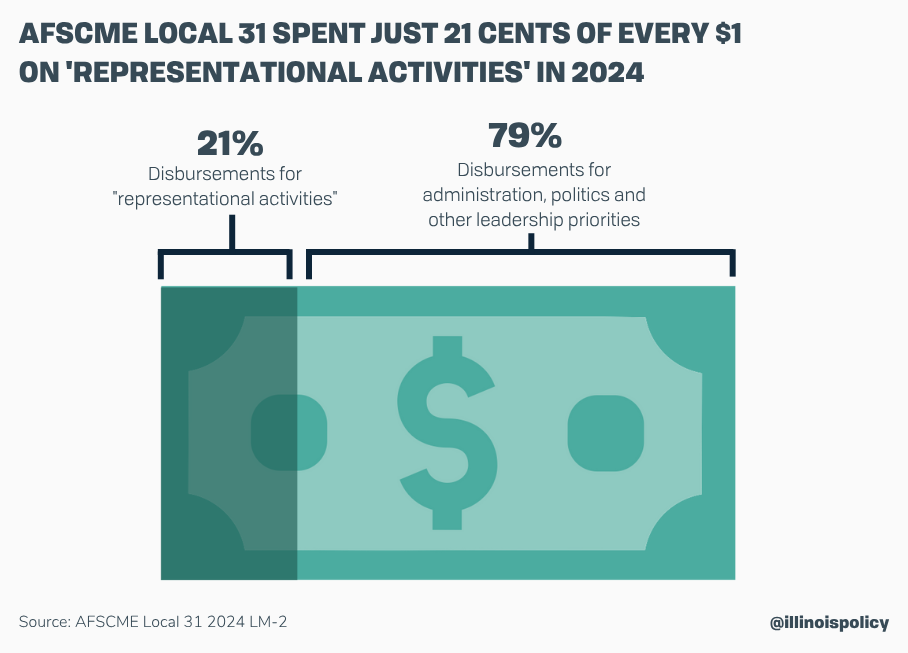
AFSCME Council 31’s total reported spending in 2024 was $47.8 million. Yet just $10.2 was spent on representing workers – what should be the core purpose of the union. The rest was spent on administration, politics and other leadership priorities.
The percentage of its spending on representation is down from 2023, when 23% of the union’s spending was on representing workers.
To put this in perspective, the Better Business Bureau’s Wise Giving Alliance states at least 65% of a nonprofit’s total expenses should be used for program activities.
While the Wise Giving Alliance evaluates spending by charities, it stands to reason AFSCME Council 31’s spending of just 21% on representation – the purpose of a union – should be a cause for concern among members.
AFSCME Council 31 spent nearly $1.5 million on politics in 2024
AFSCME Council 31 reported spending nearly $1.5 million on “political activities and lobbying” in 2024. That’s up from the nearly $1.3 million it spent in 2023.
Of that amount, $260,000 in “dues allocated to political” was directed to the AFSCME Council 31 political account. From there, members have no say on how the money is spent. Another $176,000 was spent on apartments and hotels.
But not all of AFSCME Council 31’s political spending was explicitly itemized in its report. For example, more than $1 million went to officer and employee salaries for their political work and lobbying. Members have no way of knowing on what causes or candidate campaigns those employees were working.
That political spending does not include the $274,000 in additional “contributions, gifts, and grants” the union made, which often can be political in nature. For example, the union funneled $15,000 to Citizen Action Illinois, which bills itself as “leading the way in the fight for the progressive agenda.”
Nearly half of AFSCME Council 31’s own officers and employees made over $100,000 in 2024
Those who work for AFSCME Council 31 are well compensated. Of the union’s 151 officers and employees, 73 earned over $100,000. It’s highest earner: Associate Director Michael Newman, who banked more than $195,000. Executive Director Roberta Lynch took home more than $175,000.
In total, the union spent more than $12.5 million on its own officer and employee salaries.
AFSCME Council 31’s reporting revealed other questionable spending
Unions’ federal reports can offer a lot of spending information. For AFSCME Council 31, it reveals questionable spending. For example, the union spent over $101,000 on hotels, restaurants and “auto dealers” for unspecified purposes. Members have no way of knowing why that money was spent and if it was for responsible purposes that advance workers’ interests.
Other questionable expenses included the following:
- More than $153,000 for a California “event planner” for an “international convention.”
- More than $28,000 for executive board dinners in Springfield.
- More than $21,000 for its staff holiday parties.
AFSCME Council 31 members can opt out of the union and stop paying dues
State and local government workers may not agree with the union’s spending practices, or they may feel the union doesn’t represent them well. The union’s own reporting bears that out.
As John Moss, a former president of an AFSCME local put it, “[AFSCME Council 31] never had any backing for us at all. They never would stand up for us, they never did anything for us. We weren’t being represented. They wanted our dues, [and] to increase our dues … The only thing they want to benefit is themselves, their own checkbooks.”
Whatever the reason, government workers don’t have to be union members to keep their jobs.
By opting out of union membership, workers can stop paying dues to the union yet retain all benefits that are provided in the collective bargaining agreement with their government employer. Learn more at LeaveAFSCME.com.



Leave a Reply